
Projects
Schlieren Visualization of Anti Icing Thermo Fluid Interaction on an Airfoil

This project uses a schlieren imaging setup to visualize how heat from anti-icing elements alters airflow over an aircraft wing at various temperatures and angles of attack. The qualitative analysis reveals that higher wing temperatures contribute to an earlier onset of flow separation, potentially impacting the aircraft’s aerodynamic performance.
Performance Enhancement of a Modular Low-Speed Wind Tunnel
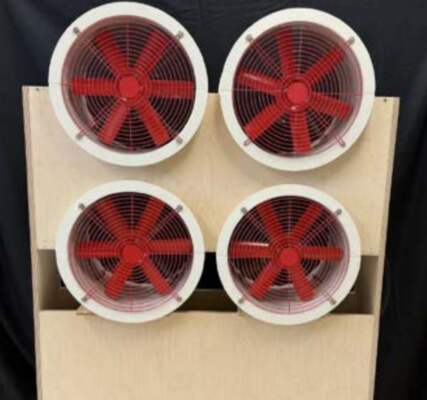
This project details the characterization and upgrade of a custom, modular, low-speed wind tunnel designed to achieve uniform airflow for versatile aerodynamic research. By using initial velocity profile data to size and integrate higher-performance fans, the tunnel’s maximum velocity was successfully increased to meet design requirements and expand the range of obtainable Reynolds numbers.
Design and Characterization of a Modular Wind Wall for VTOL and Fixed Wing UAV Testing
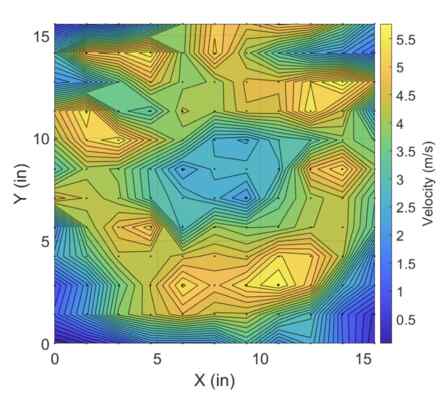
This project evaluates a modular, stackable wind wall designed to provide a cost-effective, controlled environment for testing UAV aerodynamics under realistic wind conditions. By analyzing a single-duct module with a seven-hole probe system, the study refines key design parameters—such as mesh spacing and duct geometry—to minimize turbulence and ensure high-quality airflow.

This project utilizes off-surface flow visualization—employing a laser line generator and liquid seeding particles—to capture and analyze previously hidden streamlines over an airfoil. By recording these illuminated flow patterns with high-speed cameras, the non-invasive setup provides critical qualitative data on laminar flow, turbulence, and the exact location of flow separation points.